Nobody screenshots an API response and posts it in your support channel. But when an API silently returns the wrong data, or fails under load, or doesn't handle an edge case correctly, the person who eventually notices is a real user staring at a broken screen, wondering what they did wrong.
APIs are the connective tissue of modern products. Testing them properly is one of the highest-leverage things a QA process can do, because a single API bug can quietly break every client that depends on it.
What API testing actually covers
API testing isn't one thing, it's a set of related disciplines that together validate the contract between your systems and everything that depends on them:
- Functional testing. Does each endpoint return the right data, for the right inputs, with the right status code?
- Contract and schema validation. Does the response shape match what every client expects, even as the API evolves?
- Authentication and authorization. Can a user only access what they're supposed to, every time, with no gaps?
- Error handling. When something goes wrong upstream, does the API fail clearly, or does it fail silently and pass bad data downstream?
- Performance under load. Does response time hold up when real traffic hits, not just a single test request?
Why status codes alone aren't enough
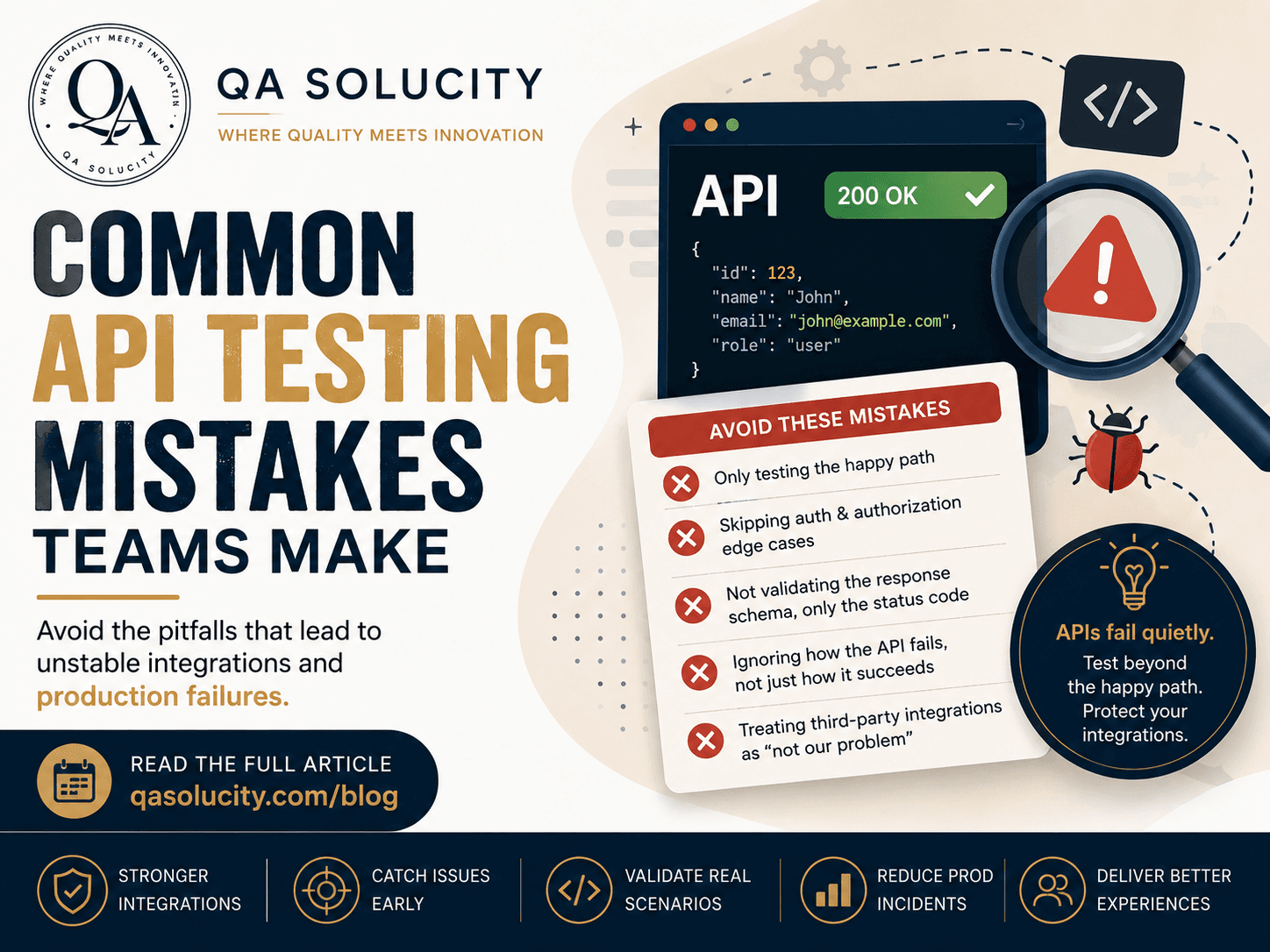
A 200 OK tells you the request didn't crash. It doesn't tell you the response is correct. We see this mistake constantly: a test suite that's green across the board, sitting on top of an API quietly returning malformed or incomplete data because nobody validated the actual response shape.
// This test passes, but tells you almost nothing
expect(response.status).toBe(200);

// This test actually validates the contract
expect(response.status).toBe(200);
expect(response.body).toMatchSchema(orderSchema);
expect(response.body.total).toBeGreaterThan(0);
The gap between those two tests is exactly where production incidents live.
Testing the failure modes, not just the success path
The most valuable API tests are often the ones nobody wants to write: what happens when a required field is missing, when a token has expired, when a downstream service times out. These scenarios are rare in a demo and common in production, at scale, over enough time, everything happens eventually.
If your API test suite has never deliberately sent it a broken request, you don't actually know how it behaves when one arrives for real.
Tools we rely on
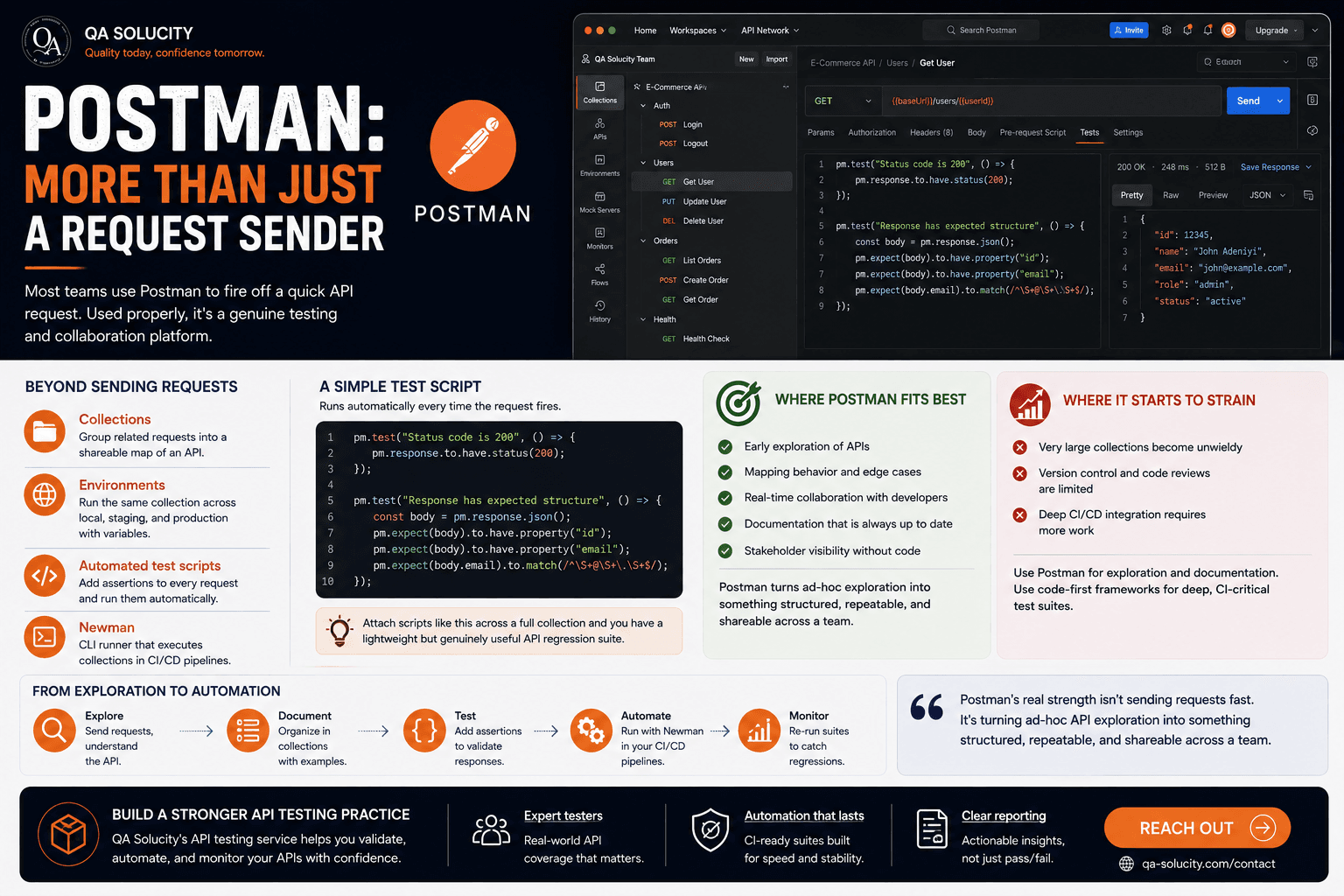
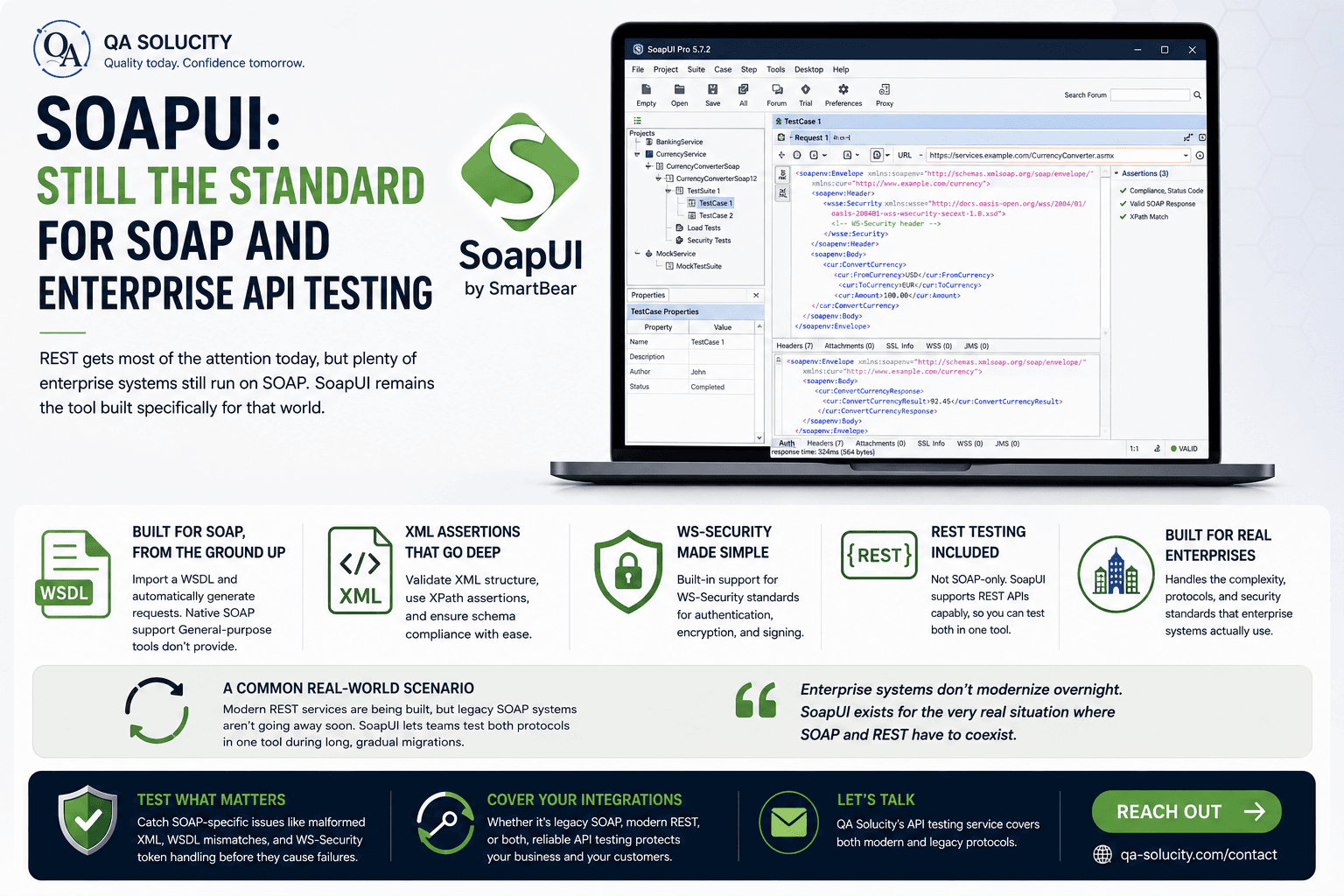
Depending on the project, we build API test suites using Postman for exploratory and collaborative testing, and code-first frameworks for CI-integrated regression coverage, validating everything from authentication flows to third-party integration resilience.
Testing the layer users never see is exactly what keeps the layer they do see working reliably. If your integrations need that level of scrutiny, QA Solucity's API testing service is built for it, and we've written more on the common mistakes teams make along the way. Talk to us about your integration landscape.