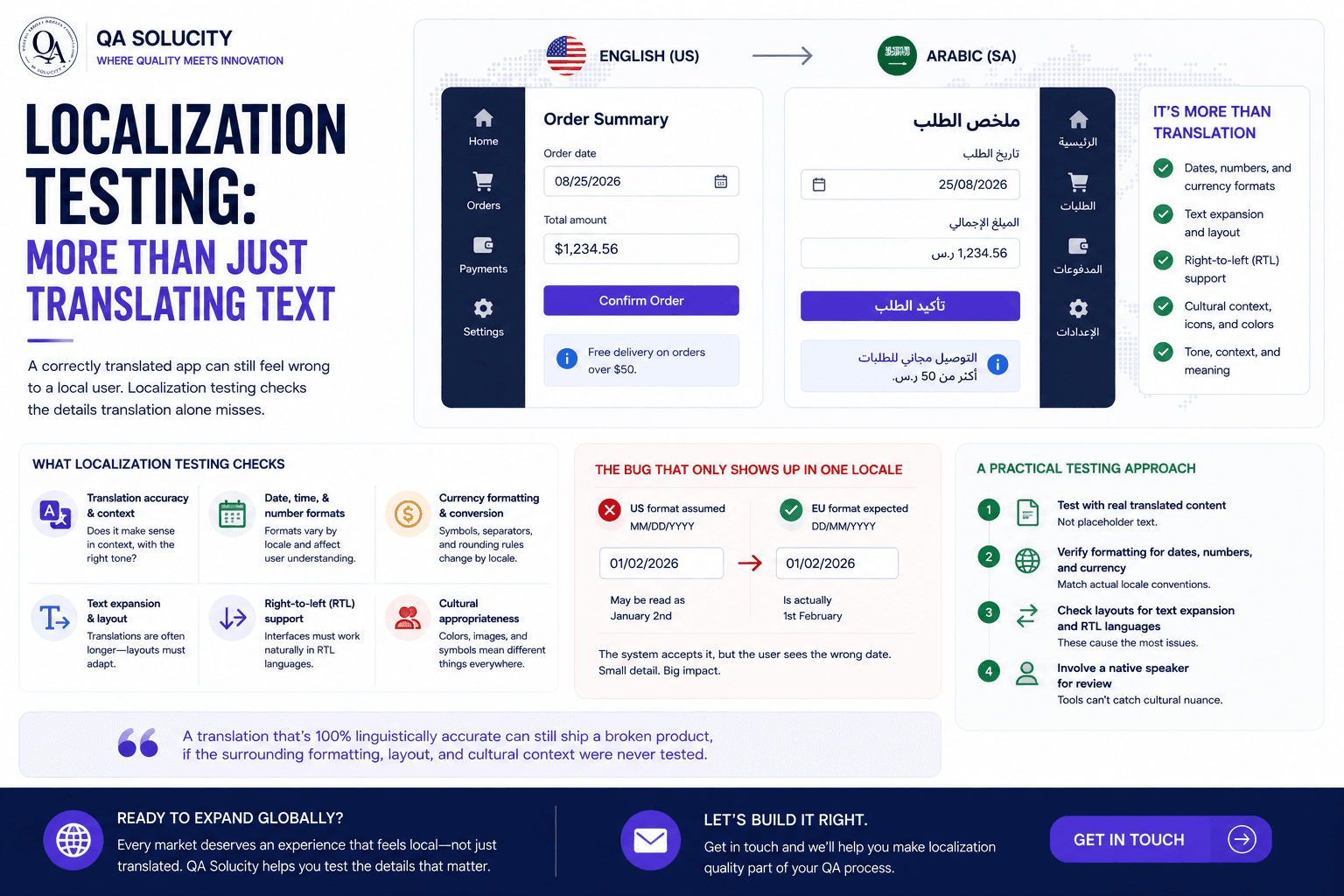
Globalization testing gets confused with localization testing constantly, and the distinction actually matters. Localization testing checks whether a specific translation and locale adaptation works correctly. Globalization testing checks something more foundational: whether your product's underlying architecture can support any locale at all, before you've committed to translating a single string.
The question globalization testing answers
Localization asks "does the French version work correctly?" Globalization asks "could we support French, or Arabic, or Japanese, without a rewrite, if we decided to tomorrow?"
That's a structural question, not a content question, and it's much cheaper to answer early than to discover the answer is "no" after you've already invested in translation.
What globalization testing actually checks
- Character encoding support. Does the system correctly handle Unicode across the entire stack, database, API, frontend, not just ASCII?
- No hardcoded strings. Is user-facing text externalized into translatable resources, or scattered directly in code where it can't be swapped?
- Locale-agnostic data handling. Are dates, numbers, and currency stored and processed in a way that doesn't assume one specific format?
- Layout flexibility. Can the UI accommodate significantly longer text, or a right-to-left reading direction, without the layout breaking?
- Timezone handling. Are timestamps stored and displayed correctly for a world with more than one timezone?
Why this belongs early, not late
The cost of fixing a globalization gap scales dramatically with how late it's discovered. Externalizing hardcoded strings before they've multiplied across the codebase is a straightforward refactor. Discovering that same problem after two years of feature development, with strings hardcoded in hundreds of places, is a much bigger undertaking.
Globalization testing is the difference between "we can enter a new market in a sprint" and "we need a quarter-long rewrite before we can enter a new market at all."
A practical checklist
- Confirm the entire stack, not just the frontend, handles Unicode correctly.
- Verify no user-facing text is hardcoded directly in application code.
- Check that dates, times, and currency are stored in locale-neutral formats internally, formatted for display only at the edge.
- Test the UI with intentionally long placeholder strings to catch layout assumptions early, even before real translations exist.
- Confirm timezone-sensitive data is stored in UTC and converted for display, not stored in a single assumed local timezone.
Where this fits into product strategy
Teams often treat globalization as a "someday" concern, until "someday" becomes "we need to launch in three new markets this quarter" and the architecture isn't ready. Building globalization awareness into QA early means expansion becomes a content and translation effort, not an engineering emergency.
If international expansion is on your roadmap, even distantly, QA Solucity's QA strategy service can help assess whether your architecture is actually ready for it. Get in touch to talk through your plans.