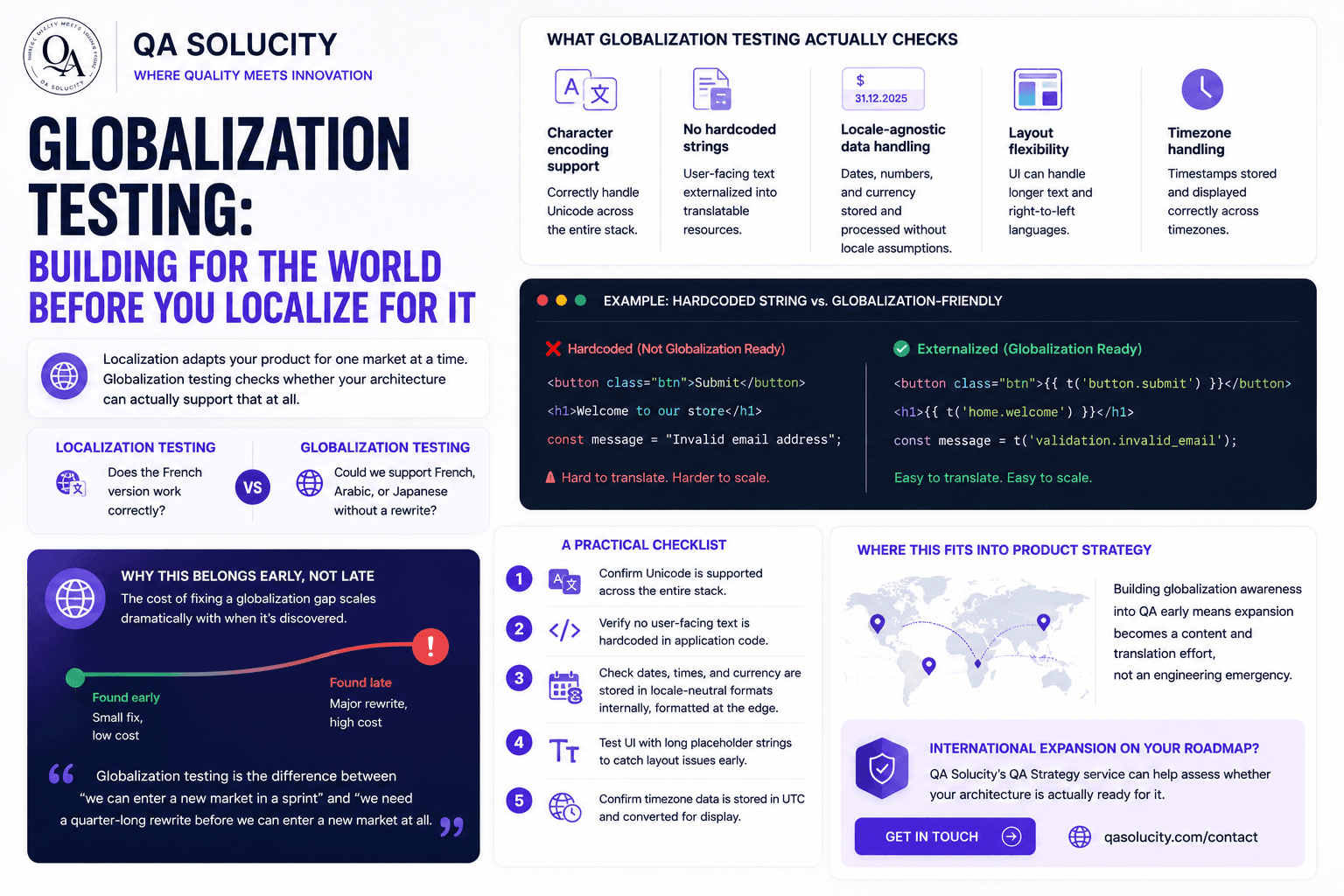
Localization is often reduced to "translate the text," and then treated as done. Real localization testing goes much further, because a product can have perfectly accurate translations and still feel broken, or even offensive, to users in a specific locale if the surrounding details are wrong.
What localization testing actually checks
- Translation accuracy and context. Not just literal correctness, does the translated text make sense in context, at the right length, with the right tone?
- Date, time, and number formats. MM/DD/YYYY versus DD/MM/YYYY isn't a minor detail, it changes what date a user thinks they're looking at.
- Currency formatting and conversion. Symbol placement, decimal separators, and rounding conventions vary meaningfully across locales.
- Text expansion and layout. German text often runs 30% longer than English for the same meaning. A button sized for English text can overflow badly once translated.
- Right-to-left (RTL) layout support. For languages like Arabic or Hebrew, an interface built without RTL in mind doesn't just look wrong, whole layouts can break.
- Cultural appropriateness. Icons, colors, and imagery carry different meanings across cultures, what reads as neutral in one market can read as inappropriate in another.
The bug that only shows up in one locale
A date field validated only against US formatting can silently accept or reject valid input incorrectly once a user in a DD/MM/YYYY locale interacts with it. A currency field that doesn't account for locale-specific decimal separators can misinterpret an entered amount entirely. These aren't cosmetic bugs, they're functional ones that only surface for users outside the locale the product was originally built and tested in.
A translation that's 100% linguistically accurate can still ship a broken product, if the surrounding formatting, layout, and cultural context were never actually tested.
A practical testing approach
- Test with real translated content, not lorem ipsum or placeholder text, layout issues from real translation length won't show up otherwise.
- Verify formatting for dates, numbers, and currency against actual locale conventions, not assumptions.
- Check layouts specifically for text expansion and RTL languages, where problems are most common.
- Involve a native speaker or reviewer for cultural and contextual accuracy translation tools alone can't catch.
Why this matters for growth
Every locale you expand into is only as good as the experience it actually delivers. A product that technically supports a language but feels subtly wrong to native users undermines trust in exactly the market you're trying to grow into.
If you're expanding into new markets and want to make sure the experience actually holds up, not just the translation, get in touch and the QA Solucity team will help you build that into your QA process.