Xray sits in the same category as Zephyr, test management built directly into JIRA rather than as a separate platform, and for many teams the choice between the two comes down to specific workflow fit rather than a dramatic capability gap. Xray's particular strength has consistently been its handling of behavior-driven development (BDD) and Cucumber-based testing.
Where Xray tends to stand out
- Strong Cucumber/Gherkin support. Teams writing tests in Given-When-Then BDD style find Xray's handling of this format notably smoother than most alternatives.
- Requirement, test, and defect traceability, natively linked through JIRA's own issue relationships, keeping everything in one connected system.
- Test execution and versioning. Test cases can be versioned alongside the requirements they verify, useful for tracking how coverage evolves as requirements change.
- API-driven automation integration. Xray's REST API makes it straightforward to feed automated test results back into JIRA, keeping manual and automated test status visible in the same place.
A BDD-style test case example
Feature: Checkout

  Scenario: Successful payment with valid card
    Given a user has items in their cart
    When they enter valid payment details
    And submit the order
    Then the order should be confirmed
    And a confirmation email should be sent
Xray manages test cases in exactly this format natively, keeping the human-readable specification and the tracked test execution in the same place, rather than a separate script disconnected from the readable requirement.
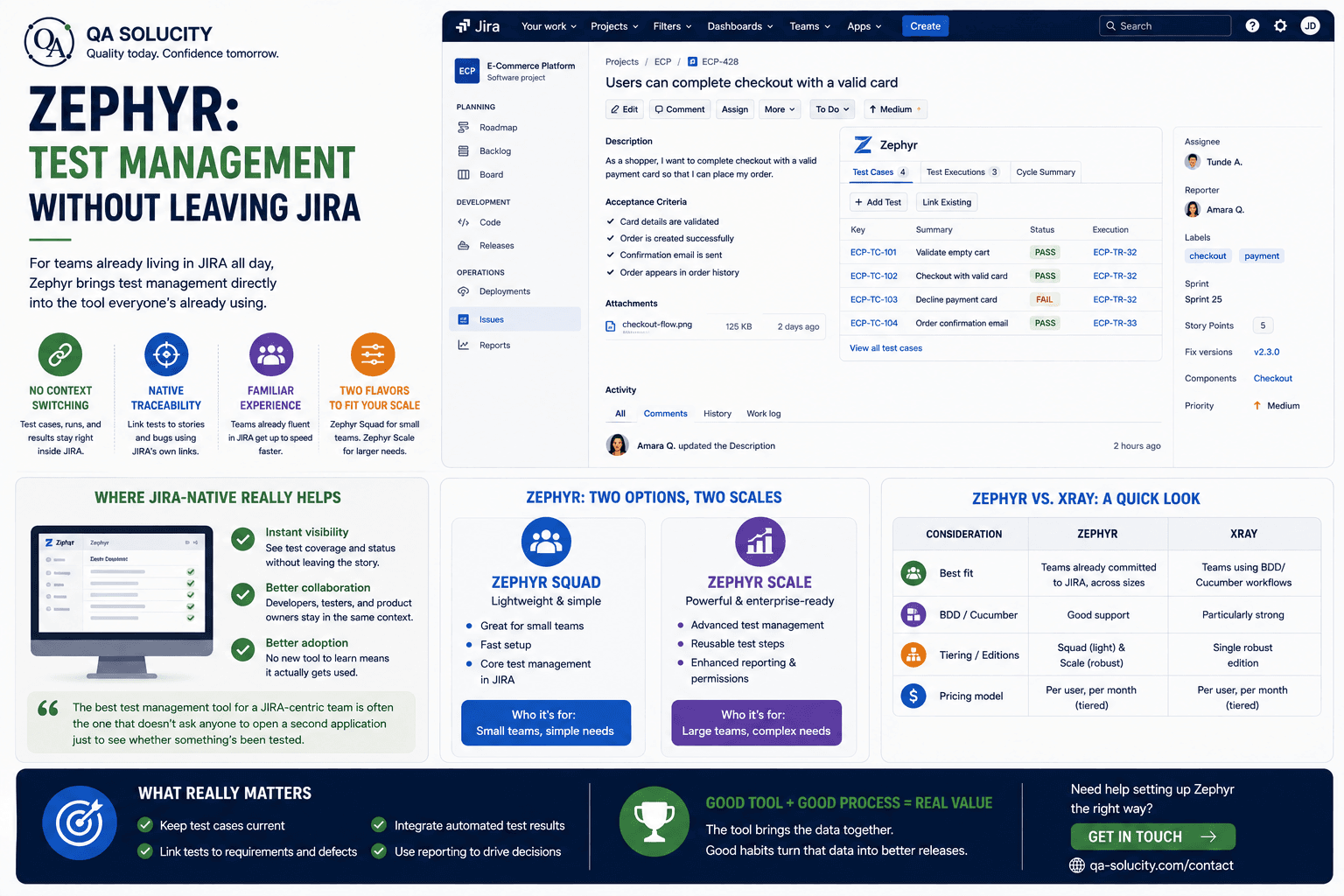
Xray vs. Zephyr, in practice
Both tools solve the same core problem inside JIRA. The practical differences usually come down to:
| Consideration | Xray | Zephyr |
|---|---|---|
| BDD/Cucumber workflows | Particularly strong | Adequate, less specialized |
| Tiering flexibility | Single robust tier | Squad (light) vs. Scale (robust) |
| Automated result integration | API-first, well documented | Also solid, slightly less BDD-focused |
If your team writes tests in Given-When-Then style, or wants tight Cucumber integration, that's usually where the decision tips toward Xray specifically.
Getting real value from JIRA-native test management
Whichever tool a team picks, the underlying discipline matters more than the platform: keeping test cases current, actually linking them to the requirements and defects they relate to, and making sure automated test results flow back in rather than living in a separate, disconnected pipeline.
If your team is evaluating JIRA-native test management, or already writes BDD-style specifications and wants tooling that matches that workflow, QA Solucity's test management service can help you set it up right. Get in touch.