Test automation has a reputation problem. Teams either avoid it too long, drowning in repetitive manual regression, or adopt it too early, building brittle suites for a product that's still changing shape every sprint. Both mistakes are expensive, just in different currencies.
The teams that get the most value from automation aren't the ones who automate the most. They're the ones who automate the right things, at the right time, with architecture built to last.
The signal that you're ready for automation
You don't need automation because a competitor has it, or because it sounds modern. You need it when a specific pattern shows up:
- You're running the same manual tests, release after release, on flows that have stabilized.
- Regression testing is starting to eat time your team needs for new feature work.
- Your release cadence is fast enough that manual regression can't keep up without cutting corners.
If none of that is true yet, automation can wait. Building a suite for a product that's still finding its shape usually means rebuilding that suite in three months anyway.
What makes automation actually pay off
A working test doesn't automatically mean a good test. The suites that hold up over time share a few traits:
- They target stable, high-value flows first. Login, checkout, core workflows, not every edge case in the product.
- They're built on solid architecture. Page objects, reusable components, and clear separation between test logic and UI selectors mean a redesign doesn't break every test.
- They run in CI/CD, not just on someone's laptop. A suite that only runs manually before release isn't really automation, it's a manual process with extra steps.
- Someone owns maintenance. Automation without an owner rots. Flaky tests get skipped, then ignored, then deleted, and you're back where you started.
A quick before/after
| Without a maintenance plan | With one |
|---|---|
| Flaky tests get muted and forgotten | Flaky tests get triaged and fixed |
| Suite runtime creeps up every sprint | Runtime is monitored and kept lean |
| New features ship without new coverage | Coverage grows alongside the product |
| Team stops trusting the suite | Team trusts a green build |
That last row is the real cost of neglected automation. A suite nobody trusts is worse than no suite at all, because it gives false confidence while still consuming time to maintain.
Our approach
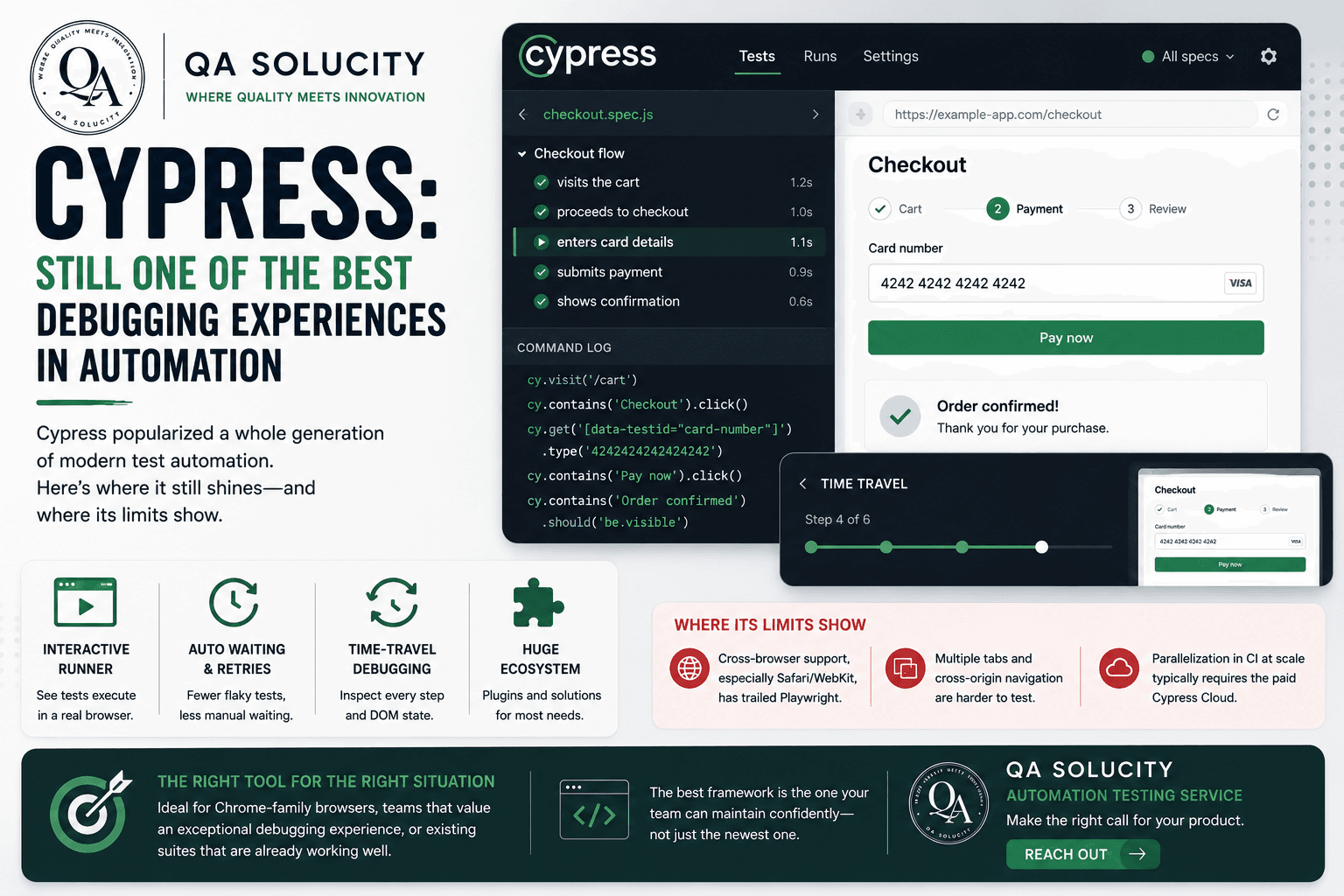
We build automation frameworks around your product's actual risk areas, using tools like Playwright and Cypress depending on your stack, integrated directly into your CI/CD pipeline so every build gets real feedback, not just the ones someone remembers to run manually.
If your team is weighing whether now is the right time to invest, QA Solucity's test automation service is a good place to start that conversation. Reach out and we'll help you figure out where automation earns its keep in your specific product.